The kita backpack: what our toddler carries to kita
Our toddler started kita with a backpack she could open and close herself. See what we pack, what we leave out, and why the bag became the goodbye ritual.
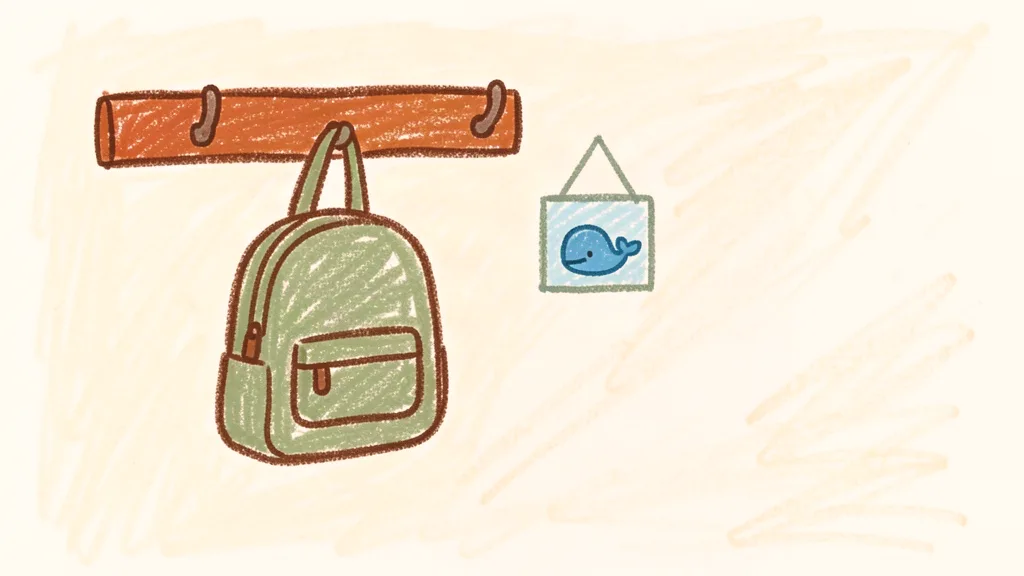
The evening before the toddler’s first kita day, I weighed her backpack on the kitchen scale. 7:12pm. The numbers surprised me: the whole kit came in under a kilo, snack box and sun hat included.
I bought the lightest backpack I could find. Then I put almost nothing in it. That was the whole point: if she carries her own bag, it has to stay light. A light bag means we pack less, which turned out to be the best kita decision we made.
The backpack is her job, not ours
The rule came from a sentence in NAEYC’s tips for parents of toddlers. Toddlers and twos can carry their own lunch boxes. They just need extra time for simple tasks; “Emptying a backpack” is literally on their list. Ours carries her backpack. It is the smallest independence project we have; it works because the stakes are low. The bag can fall. Nothing breaks; nobody is late because of it.
The kita asks for very little. Ours wanted the spare clothes, the snack box, and house shoes; everything else was optional. Every kita is different; one family’s kita needs no water bottle, while another’s needs three changes of clothes. The educators know their own room; the list they hand out is the only list that counts.
Which backpack we picked
I wanted the Affenzahn. Every kid at the kita has one; the foxes and raccoons hang in a row like a zoo. I ordered the fox version online for about 40 euros and tried it on her the evening it arrived. She tipped over backwards twice, wearing it empty. It was adorable. I returned it the same week.
The bag was the problem, not the child. Empty, it outweighed her whole kit; the clip needed two hands and a grunt. I had bought her a backpack to carry, then made it impossible for her to carry. My partner voted against the fox from the start. Her line: “the bag is for her back, not for the photo.” She was right. It took one evening and two falls for me to admit it.
The other candidate was a Fjällräven Kånken Mini I saw on a kita kid. Nice bag. Ninety euros for something a two-year-old will drag through sand is a choice I left to other families.
The winner came from the sports discounter, the same aisle as the rain suit. Twelve euros, 240 grams, one zip her hands could work, and a chest clip that clicked. Its name I never learned. That is the review.
| Affenzahn fox | Kånken Mini | Discounter bag | |
|---|---|---|---|
| Price | ~€40 | ~€90 | ~€12 |
| Weight | tipped her over, empty | no scale needed | 240g on our scale |
| Her hands | clip took two hands | adult buckles | one zip, clip that clicks |
| Outcome | returned | ruled out | still her bag |
The evening before the first day, I weighed the final kit on the kitchen scale.
| What | Weight (our kitchen scale) |
|---|---|
| Empty backpack | 240g |
| Filled snack box (Funkelfuchs, three-slot rule) | 380g |
| Sun hat | 50g |
| Total | ~670g |
The whole kit is about a third of the parent’s bag, which we weighed for the diaper bag post. That comparison was the point. A two-year-old does not carry two kilos; she carries 670 grams. She never notices it.
What goes in it (and what stays home)
The pack list is short on purpose.
- The snack box, packed the night before (the three-slot rule)
- Sun hat in summer; hat and gloves in winter
- One small comfort thing, only when she asks for it
That is the whole list. The water bottle stays home, because the kita has cups; a bottle would add 300 grams for nothing. The spare clothes stay at the kita; the Wechselsachen system lives there, not in her backpack. Toys stay home. The world stays home.
TipPack the kita’s list, not a blog’s list. Every kita is different, and the educators wrote the only list that counts.
The short list is the point, not a compromise. Every item we left out was something she did not have to carry, fall over, or lose. The kita start advice that mattered was subtraction.
The morning drill: on at the door, off at the hook
The drill is two moves. At the door, the box goes into her bag, and she puts the bag on herself. At the gate, the bag comes off and goes on her hook: the one with the whale picture. That is the whole commute.
The box goes in the bag at the door, not in the hallway and not in my hand. We packed it the night before; the morning part is one zip and one pair of shoulders. She can do the zip now, though the first weeks she could not.
On the walk she carries it, and on the Thursday run she carries it. The baby rides in the stroller or the carrier; during the door drill she sits on the mat. Both kids leave the house; only one carries a bag.
The goodbye script does not change: one sentence, one hug, hand to the educator, walk without looking back. The bag makes it easier, because she has a job at the end of it. The drop-off post has the full ritual.
The hook: how the bag became the goodbye
During the Eingewöhnung, the bag did something none of us planned. Week two, she would not put it down; she sat with it on her lap during group time. It went to the sandpit; it slept at the foot of the cot. The educators let it be. It was her transitional object, weeks before we had a word for it.
The AAP describes transitional objects as things that help children move from dependence to independence. They also reassure a child when a parent leaves. The bag was both: it smelled like home; it hung where she could see it. The room had a piece of her in it.
The first time she hung it herself was 8:14am in early July, the week after the Eingewöhnung ended. She took the bag off and held it to her chest for a second; then the whale hook had it. The educator said nothing. Neither did I.
The zip meltdown came in week three, in the middle of the rough stretch. At 8:29am the zip stuck halfway, the bag already in her hands. She pulled; it refused. The bag went flying. The scream came a second later, aimed at me. My fault: I had zipped it for her the evening before; she had decided the zip was mine.
Her rule after that morning: leave the bag open. An open bag is a bag she can manage. I closed it every evening for two weeks out of habit; she stopped fighting me and fought the bag instead. The open-bag rule survived. She does the zip now, when she feels like it.
ImportantThis is our experience, not a parenting guide. Separation and transition are normal, and every child settles differently. If the drop-off feels like more than your family can carry, ask the pediatrician or the kita educators, not a blog.
What we stopped carrying
The change showed up in the parent’s bag first; the Deuter used to hold her things. Once her backpack existed, it shrank to baby stuff: diapers and the changing mat. The toddler’s load rides on her own back.
By week six the transfer was routine. The bag went on its hook; she walked to the group. I stood at the gate with both hands free and nothing to hand over. The walk home was lighter than the walk there, not just because of the bag.
The smallest part of kita readiness is the bag. It is also the only part she can carry herself; everything else was ours to carry. That is why it is hers.
The Bottom Line
- The kita backpack is her job, not ours; keep it light enough for her to own it.
- The kita’s list wins; follow it and subtract everything else.
- One easy zip and a chest clip beat any cute animal.
- The bag became the goodbye: on at the door, off at the hook.
Filed under kita-age; everything we’ve written is in the archive. The editorial policy is the honest version of how this site works.