Our kita transition: the slow goodbye that worked
Getting our toddler into a German kita was the easy part. Letting go at the door was not. The slow-goodbye ritual that got us through the first month.
Finding a kita spot in Berlin is its own saga, and I’ll save that for another post. This one is about the part nobody prepares you for. Handing your kid over to strangers who will, within a month, know their routines better than you do.
There are two transitions in every kita start. The child’s, and the parent’s. The child’s is visible: new room, new faces, new rules. The parent’s is quieter. It’s the walk away from the door, the empty morning, the phone that stays silent. Both transitions need settling-in time. We only understood ours after the staff gently pointed it out.
What the kita called Eingewöhnung
Eingewöhnung is the German word for the settling-in period. Parent and child slowly build the kita into their map of the world, together, over weeks. It is not a drop-off. It is a transition with a schedule, and the schedule is the point.
Our kita suggested a gradual settling-in, and we were skeptical. The first days were thirty minutes. Me sitting on a tiny chair while our toddler stared at me from across the room. Day three, she wandered toward the toys. Day five, she cried when I left, and then stopped, which somehow hurt more.
The staff called it Eingewöhnung, and they were right about every step. We just had to survive the steps to believe them.
The German system takes this slowly on purpose. The child spends the first days with the parent in the room, watching, not being left. Then the separation comes in small, predictable doses. There are different models, some faster, some slower. Our kita used the patient version, the one German nurseries call the Berliner Eingewöhnungsmodell. The parent stays. The child scouts. The goodbyes grow in tiny steps. It matched our toddler’s temperament. We didn’t know enough to have an opinion at the start. By the end, we were converts.
The parent’s job in those days is deceptively simple: sit still and be boring. The child needs a stable base to explore from. The boredom is the point. Every time we rushed the process, the toddler felt it. Every time we relaxed, so did she.
The settling-in timeline
Here’s how the first month actually went, in our house. We kept notes that month, and the kita gave us their written plan. The methodology was simple: each evening, we wrote down how the goodbye went, and the plan gave us the phases.
| Day | What happened | What we learned |
|---|---|---|
| Day 1-2 | 30-minute visits, she stared at me from across the room | Sitting still is the job |
| Day 3 | She wandered toward the toys | She was scouting, not suffering |
| Day 5 | She cried at goodbye, then stopped | The crying was the script, not the disaster |
| Week 2 | A crying morning that nearly broke me | Fine within five minutes. The crying was for me |
| Week 4 | She ran in without looking back | Both our hearts broke, differently |
There is a shape worth knowing: nothing happens on day one. The scouting starts before the trusting. The crying peaks around the first real goodbyes, then fades. The running-in arrives suddenly, and it arrives without warning. Each phase felt permanent while we were in it. Each one passed on schedule.
The ritual that worked
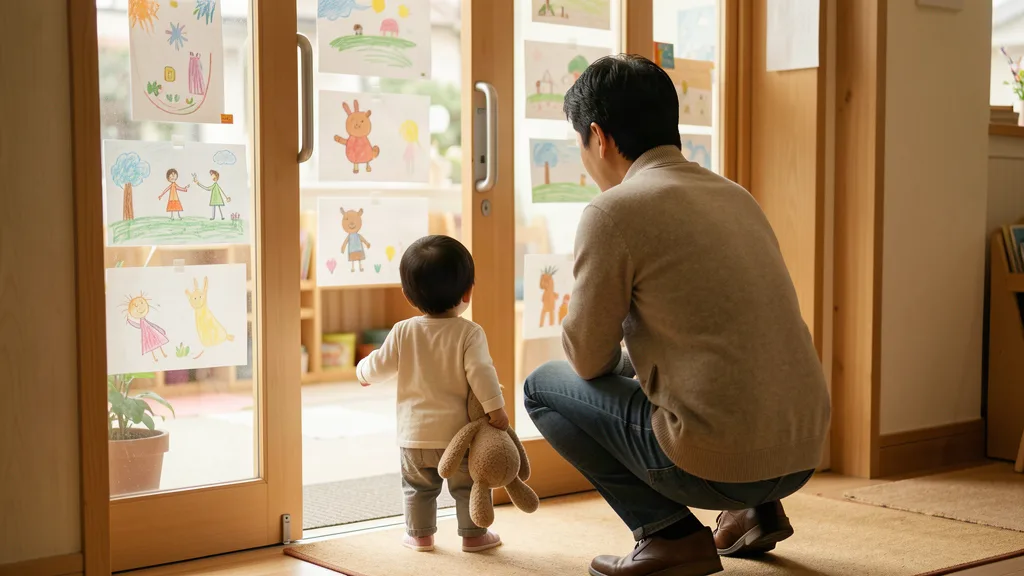
Same words every time. “Papa is going now, I’ll be back after Mittagessen.” Same wave, same spot at the window. No sneaking out. The kita staff told us the sneaking-out strategy backfires because the kid learns that adults vanish unpredictably. The American Academy of Pediatrics says the same: predictable, rehearsed goodbyes ease separation anxiety, and practice helps. Our toddler tested the boundary exactly twice, then accepted the script.
The script, as we ran it:
| The script | Same every morning |
|---|---|
| The words | “Papa is going now, I’ll be back after Mittagessen.” |
| The wave | Same wave, same spot at the window |
| The rule | No sneaking out, ever |
| The test | She tested the boundary twice, then accepted it |
TipSame words, same wave, same window. The kid learns the script, and so do you. No sneaking out, ever.
The script worked because it was identical every morning. Not similar. Identical. The toddler could predict the goodbye down to the pause before the door. Predictability is the whole product. The words matter less than the fact that they never change.
NoteThe crying morning in week two taught us the difference. She was fine within five minutes, and the staff called at lunch to prove it. The crying was for me, not from fear. That distinction helped more than any article we read. It is the same distinction our separation anxiety post tries to name. The goodbye looks like distress, and mostly it is a script being learned.
What helped most, in order
The same drop-off person every day. We stopped alternating. Familiarity beat fairness. The AAP’s drop-off advice agrees: a calm, consistent goodbye makes the separation easier.
The alternating sounded fair and felt chaotic. One parent did mornings, then the other, and the toddler never knew who would vanish at the door. A single regular face made the goodbye a known quantity. The fairness we gave up was worth less than the calm we got.
A comfort item she chose herself. A worn stuffed animal, not a fancy new one.
The worn one had the history. It smelled like home and had survived a year of bedtime negotiations. A new comfort item is just a toy with good intentions. The chosen one did the actual work.
The three helped in that order for a reason. The familiar face made the room predictable, the comfort item made it portable, and the calm made the goodbye survivable. Remove any one, and the other two have to work harder.
Me staying calm at the door. She read my face. On mornings I was rushed or anxious, drop-off was harder. That was the most humbling discovery of the whole process.
The face was the leak. I thought I was hiding the stress, but she didn’t read my words or my tone. She read the tension in the shoulders and the hurry in the goodbye. Calm had to be manufactured before the walk to the door, not at the door itself.
The bad days
Week two had a crying morning that nearly broke me. I stood outside the kita gate for ten minutes, listening. The staff called me at lunch: she’d been fine within five minutes and had eaten twice. The crying was for me, not from fear. That distinction helped more than any article. Setbacks like that morning are part of the arc, not a sign it failed. Our settling-in setbacks post keeps the honest count of how long each one lasted.
Those ten minutes at the gate were the longest ten minutes of the month. The staff call was the shortest phone call of the month. The gap between what I imagined and what actually happened was the whole lesson.
We asked the kita staff every question we had: naps, food, the German-only policy. They were patient with our beginner German. If your kita has an open-door policy, use it. It costs you half an hour and buys real peace of mind.
The bad days taught us the questions to ask. How long was the crying? What did she eat? Did she join the circle? The answers were always more reassuring than the silence we imagined. Asking became our coping mechanism, and the staff never once made us feel silly for it.
The kita bag
The bag was our other anxiety, and it had a simple fix: a checklist that never changed. (The exact contents, and what we leave out, have their own kita backpack post.)
- Two changes of clothes, in the current size
- Rain gear and indoor shoes
- Spare socks, always
- The comfort item she chose
- Whatever the kita’s own list says
The kita’s list is the real list. Ours was just the backup. Checking the same five boxes each morning turned a nightly worry into a thirty-second task.
Why predictability wins
The slow goodbye is really the same principle as a boring, consistent routine beating meltdowns. Kids calm down when the script never changes. And once I’d been the default parent for a week, I understood the drop-off routine. I get nap time now too. It’s not a ritual. It’s the load-bearing wall.
The routine carried both of us. The toddler got a goodbye she could predict, and I got a morning I could execute without thinking. Routines look like they’re for children. They’re for the adults too. The whole settling-in story, from the first thirty-minute visit to the running-in, is in our Eingewöhnung experience post.
Questions we get about the kita transition
What if we can't do the slow settling-in because of work?
Talk to the kita before you panic. Many offer a compressed version, and some have staff who can cover the sitting phase. We made it work with shifts at the edge of the workday. Ask first. The answer is usually more flexible than the fear.
What if the crying lasts longer than a month?
We'd talk to the kita staff first, because they've seen more transitions than any book. They told us the red flags and the normal range, and our normal range was wider than we expected. If it goes beyond that, a professional's view is the next step, not another article.
Do we really have to stay in the room the whole time?
In the slow model, yes, and it felt like a waste of time until it wasn't. The sitting days are the investment. The toddler is building a map of the room with you as the safe base. Skip the sitting and the map has no anchor.
What if she seems fine and then regresses?
Regressions mid-transition are normal, and they are not a restart. The script holds. Same words, same wave, same window. The toddler tests the boundary, remembers the script, and settles back into it. Ours dipped in week two and was running in by week four.
The Bottom Line
- A predictable, slow goodbye beats any clever trick.
- Same words, same wave, same window. The kid learns the script, and so do you.
- The crying mornings pass. They are almost never what they look like.
- By week four, our toddler ran in without looking back, which was, of course, its own little heartbreak.
Filed under kita-age; everything we’ve written is in the archive. Our accuracy and sourcing rules live on the editorial policy page.